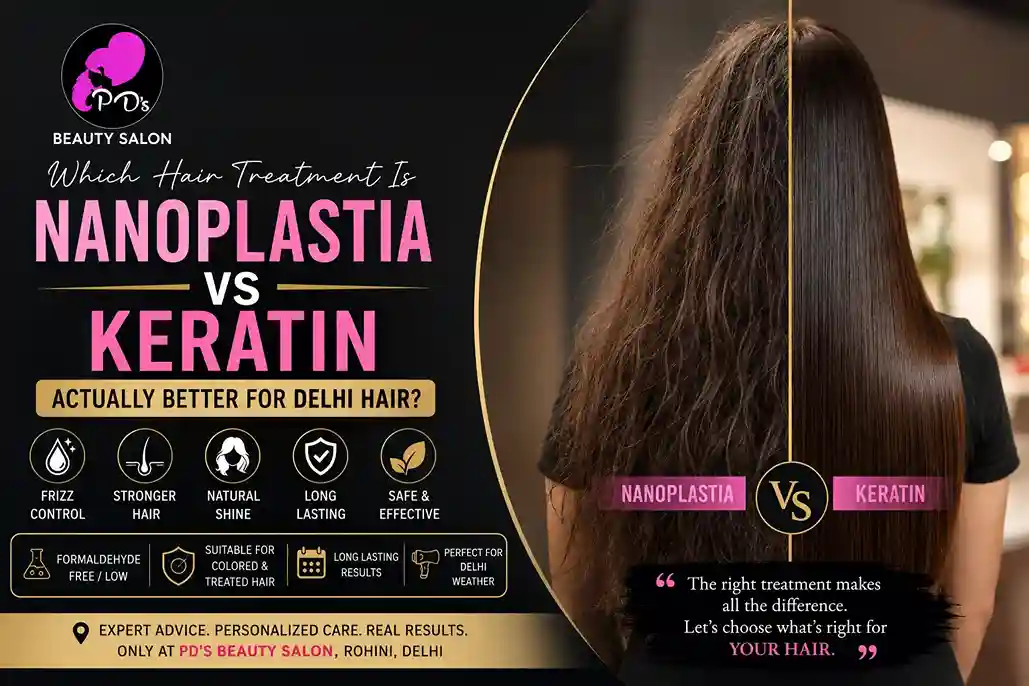
Quick Summary:
Both are popular hair smoothing treatments lasting 3–5 months. Nanoplastia uses amino acids to repair hair from within — best for damaged, fine, or colour-treated hair, with a natural finish. Keratin coats the hair cuticle for a sleek, high-gloss look — best for thick, coarse, or very frizzy hair. Both require sulfate-free shampoo and similar aftercare. Delhi's heat, pollution, and hard water make aftercare especially critical. The right choice depends on your hair type — a proper consultation before booking is always recommended.
If you've ever walked out of the house on a humid July morning with perfectly blow-dried hair — and arrived at your destination looking like you stuck a fork in a socket — you already know what Delhi does to hair. The combination of heat, pollution, hard water, and monsoon frizz makes smooth hair feel like a temporary luxury.
So when clients come into PD’s Beauty Salon asking about nanoplastia treatment in Delhi, or weighing it against keratin, the question is never just about which one looks nicer. It's about which one actually survives real life here — in this city, in this weather, with this water.
After 15 years of treating Delhi hair across every type, texture, and level of damage, I've seen both treatments deliver extraordinary results and both treatments fail — and the difference almost always comes down to one thing: choosing the right treatment for the right hair, not just the one that's trending. Whether it's nanoplastia, keratin, rebonding, or a hair spa our full range of hair treatments in Rohini starts with a proper assessment, not a menu.
What Is Nanoplastia Treatment?
Nanoplastia is an amino acid-based hair smoothing treatment. It works by infusing the hair shaft with hydrolysed proteins, amino acids, and collagen — essentially rebuilding the hair from within, rather than just coating it on the outside. One of its biggest selling points is that it's formaldehyde-free or contains only trace, safe levels — which matters more than people realise when you're sitting in a salon chair for three hours.
The result is smoother, softer hair that still moves naturally. It doesn't make your hair pin-straight like a rebonding treatment. Think of it more as your hair behaving like it does on a good hair day, every day. Fine and medium hair types tend to love it most, and it works beautifully on colour-treated or previously processed hair too.
What Is Keratin Treatment?
Keratin treatment is a protein-based smoothing process that coats the hair cuticle with a keratin formula — usually activated with heat — which reduces frizz and adds noticeable shine. Most good-quality formulas today are low in formaldehyde or completely free of it, though it's always worth asking your stylist specifically about the brand being used.
Keratin works well on thick, coarse, or very frizzy hair. If someone comes in with dense, high-volume hair that's resistant to styling, keratin often delivers a more dramatic smoothing result — easier to blow-dry, holds styles longer, glossy finish.
One thing we notice regularly at PD’s Beauty: clients with medium-density hair sometimes find keratin leaves their hair feeling slightly stiff for the first few weeks, especially if applied too heavily. It's smoother — but in a more 'done' way. That polished, sleek finish suits some clients perfectly and feels too rigid for others. Knowing which one you are before you commit is exactly what the consultation is for.
Nanoplastia vs Keratin: The Honest Side-by-Side
Both treatments have overlapping benefits, but they work differently and suit different hair concerns. Here's a clear comparison — the same one we walk through with clients during consultation at PD’s Beauty Salon:
Nanoplastia
- The main ingredients are amino acids and collagen
- Completely formaldehyde-free or contains only trace amounts
- Gives moderate straightness with a natural fluid finish
- Controls frizz excellently
- Gives a natural soft shine
- Repairs hair from within
- Best suited for damaged, fine and coloured hair
- Hair retains high natural movement and stays fluid
- Lasts 3 to 5 months
- Very good humidity resistance
- Completely colour safe
- Low and easy aftercare
Keratin
- The main ingredient is keratin protein
- Low to no formaldehyde, but always check the brand
- Gives moderate to high straightness
- Controls frizz excellently
- Gives a high gloss polished shine
- Smooths and coats the hair surface
- Best suited for thick, coarse and frizzy hair
- Moderate natural movement — hair looks best kept straight
- Lasts 3 to 5 months
- Very good humidity resistance
- Generally colour safe, but always check the formula
- Low to moderate aftercare required
The core difference: nanoplastia repairs the hair from within. Keratin smooths and controls from the outside. For hair that genuinely needs care — not just control — nanoplastia tends to be the better fit. For hair that needs taming more than healing, keratin often wins.
Which Treatment Is Right for Your Hair Type?
This is the question that should drive every decision — not which treatment is trending on Instagram. At PD’s Beauty Salon, this is always the starting point before we recommend anything.
Damaged or over-processed hair → Nanoplastia
The amino acids actively rebuild hair structure from within. Keratin sits on top of damage without addressing what's underneath. If your hair has been through chemical processing, heat damage, or repeated colouring, nanoplastia does more than just smooth.
Very frizzy or thick hair → Keratin
For dense, high-volume hair where taming is the primary goal, keratin typically delivers a more dramatic smoothing result. If frizz control is everything and your hair is genuinely coarse, keratin is reliable and effective.
Colour-treated or highlighted hair → Nanoplastia
Nanoplastia is gentler on colour and less likely to affect vibrancy. After bleaching or balayage, the hair is porous and fragile — nanoplastia's conditioning approach is significantly safer than a heavy keratin application.
Thin or fine hair → Nanoplastia
Keratin can weigh fine hair down and leave it flat. Nanoplastia keeps fine hair light, bouncy, and natural. It adds body without the heaviness.
Curly hair → Depends on how much you want to reduce curl
Both treatments reduce curl significantly. If you want to preserve some wave and keep natural movement, nanoplastia leaves more texture. If you want straighter results, keratin is more effective at reducing curl pattern.
Dry or brittle hair → Nanoplastia, without question
It adds moisture and protein together — exactly what dry, brittle hair needs. It hydrates as it smooths, rather than simply sealing the cuticle down.
Chemically treated hair (rebonded, relaxed) → Consultation first
This needs a proper in-person assessment before either treatment. Current hair condition determines everything. At PD’s Beauty, we will not recommend a treatment on chemically processed hair without first examining it — the risk of damage is too high to ignore.
If you're still not sure which applies to you, that's exactly what our consultation is for. Come in, let us look at your hair properly, and we'll tell you honestly what it needs.
How Long Do Results Last?
Three to five months is the honest answer for both treatments. But 'three to five months' in Delhi is not the same as three to five months anywhere else. Hard water strips smoothness faster. Pollution dulls shine. Monsoon humidity tests even the best treatment. Without proper aftercare, results can start fading closer to the three-month mark rather than the five. For brides in particular, timing this correctly is critical — we cover the full pre-wedding hair and skin schedule on our bridal packages page.
At PD’s Beauty Salon, we give every client a written aftercare guide at the end of their treatment session — because we've seen enough results ruined in the first two weeks at home to know that the treatment is only half the story.
Aftercare That Actually Makes a Difference
The clients who get the best results from both nanoplastia and keratin are the ones who follow aftercare properly. These aren't optional suggestions — they directly affect how long your results last:
• Switch to a sulfate-free shampoo immediately — This is non-negotiable. Sulfate shampoos strip the treatment in weeks. A good sulfate-free shampoo is the single highest-impact thing you can do to extend your results.
• Wait 72 hours before the first wash — The treatment bonds over 48–72 hours. Washing too early — even with clean water — disrupts the bonding process. This is the most common mistake we see.
• Wash 2–3 times a week, not daily — Frequent washing shortens results. Dry shampoo between washes is your friend.
• Use a heat protectant every time — Before blow-drying, straightening, or any heat styling. Without it, heat slowly breaks down the treatment.
• Avoid heavy oiling in the first month — A light serum on the lengths is fine. Thick oils applied to the scalp and repeatedly washed off with harsh shampoos actively work against the treatment.
• Avoid chlorinated or hard water on holiday — Swimming in a chlorinated pool undoes results significantly faster than anything else. If you're going on holiday shortly after the treatment, this is worth planning around.
• Book a protein hair spa every 6–8 weeks — This maintains the treatment's effect between sessions and keeps hair in genuinely good condition. It's a small investment that makes a noticeable difference to longevity.
Mistakes People Make After Hair Treatments — And How to Avoid Them
A treatment going wrong is not always the salon's fault. What happens at home in the weeks following the treatment matters just as much as what happens in the chair. Here are the mistakes we see most often:
• Washing too early — The treatment needs 48–72 hours to bond fully. Water disrupts this process. We tell every client this before they leave — and we still hear from people who washed their hair on day one because it 'felt like it needed it'. Resist it.
• Using a sulfate shampoo — People spend thousands on a professional treatment and then strip it in two weeks with a cheap shampoo. If you only change one thing after a treatment, make it this.
• Heavy oiling — Thick oils applied to the scalp, repeatedly washed off with harsh products, work directly against the treatment's effect. Use a light serum on the ends only, applied when the hair is dry.
• Skipping the strand test on damaged hair — A good stylist will assess porosity, damage level, and texture before recommending anything. If a salon skips that step — if they quote you a treatment over the phone without ever seeing your hair — that's worth noticing.
• Booking a treatment too soon after bleaching — Very recently bleached hair (within four to six weeks) is porous and fragile. Applying a smoothing treatment without a proper strand test can cause significant breakage.
Nanoplastia Treatment Cost in Delhi — What to Actually Expect
Pricing varies depending on hair length, density, product brand, and the expertise of the team applying it. At PD’s Beauty Salon in Rohini, we'll always tell you the exact price after assessing your hair — because two clients with different hair lengths and densities shouldn't pay the same amount, and we don't think pretending otherwise is fair.
What is worth understanding about pricing in general: unusually low prices for professional smoothing treatments almost always mean one of three things — a diluted product, a shorter processing time than the treatment requires, or a less experienced technician. Any of these directly affects your result. A treatment that damages your hair further isn't a deal. It's a setback that costs more to fix than the original treatment would have.
What to ask any salon before booking:
Which product brand are they using? Is it formaldehyde-free, and do they do a strand test on damaged or coloured hair beforehand? The answers to those three questions tell you most of what you need to know about their standards.
This is also something we teach in depth in our hair styling and hair designing courses in Rohini, so students understand not just how to apply treatments, but why product quality and assessment matter.
At PD’s Beauty Salon, we use professional-grade, tested products — and we do a full consultation before every treatment. Contact us for current pricing on either treatment across both our Rohini branches.
Who Should Avoid These Treatments?
Active hair fall or a sensitive, irritated scalp — pause before booking either treatment. Both involve heat and chemical bonding, and neither is ideal when the scalp is already compromised. We will always ask about scalp condition before proceeding, and if there's active sensitivity, we'll recommend addressing that first.
Very recently bleached hair (within four to six weeks) — needs careful assessment before any smoothing treatment. Bleached hair is porous and fragile. Without a strand test, applying a smoothing treatment can cause significant breakage. This is not a risk worth taking to save a consultation step.
Extremely damaged hair — significant breakage or multiple rounds of chemical processing — may need a restoration plan before any smoothing treatment is applied. At PD’s Beauty, we will sometimes sit across from a client and say: not yet. Your hair needs to be in better condition before we add anything else to it. That's not something every salon will tell you — but it's the right answer when it's true.
So — Nanoplastia or Keratin?
If your hair is damaged, fine, colour-treated, or needs genuine repair — nanoplastia. If your hair is thick, coarse, very frizzy, and needs serious taming above all else — keratin. If you're not sure, the honest answer is: come in and let someone who has been treating Delhi hair for 15 years take a proper look.
Both treatments, done correctly on the right hair, with the right products and proper aftercare, can genuinely change your relationship with your hair. The difference between a good result and a great one is almost never the treatment itself. It's the assessment before it and the care after it.
Ready to find out which treatment is right for your hair? Book a consultation or call us directly — Rohini Sector 7: +91 81306 16206 | Sector 8: +91 85878 71230. Open 7 days, 10AM to 8PM.
Frequently Asked Questions — Nanoplastia & Keratin
Is nanoplastia safer than keratin?
Generally, yes — it's amino acid-based and formaldehyde-free, making it gentler on both hair and scalp. Modern keratin formulas are also largely safe, but for sensitive scalps or damaged hair, nanoplastia carries lower risk. At PD’s Beauty Salon, we use formaldehyde-free versions of both and always confirm suitability during the consultation.
Which lasts longer: nanoplastia or keratin?
Both last 3–5 months. Keratin can run slightly longer on coarse or thick hair. In Delhi specifically, aftercare affects longevity more than the treatment type — hard water and pollution are the real enemies of lasting results. A sulfate-free shampoo and a protein hair spa every 6–8 weeks make a significant difference.
Is nanoplastia good for damaged hair?
Yes — it's one of the better options specifically because the amino acids repair the hair shaft from within, rather than just smoothing the surface. For hair that has been through repeated chemical processing or heat damage, nanoplastia does the work that keratin can't. That said, very severely damaged hair may need a restoration plan first — something our team will assess honestly.
Does nanoplastia permanently straighten hair?
No. It smooths and significantly reduces frizz with a natural finish, but your hair texture gradually returns as it grows out over 3–5 months. It's not a permanent treatment — which is actually part of its appeal for clients who want improvement without a lifetime commitment to a particular style.
Is keratin better for frizz?
Keratin is very effective at frizz control, especially on thick or coarse hair where maximum smoothing is the goal. Nanoplastia also controls frizz well — with a slightly more natural finish. For the most dramatic anti-frizz result, keratin usually edges ahead. For a natural, touchable finish with good frizz control, nanoplastia is the better fit.
Can coloured hair get nanoplastia?
Yes — and we often recommend it specifically for coloured hair. Nanoplastia is colour-safe and can actually improve the condition of chemically treated hair. Keratin can also be applied to coloured hair, but the formula matters — always confirm with your stylist that the specific product being used is colour-safe.
Which treatment looks more natural?
Nanoplastia gives a more natural, lived-in finish. The hair looks like yours on a great day — smooth, fluid, with movement. Keratin gives a more polished, sleek look that reads as more styled. Some clients prefer that finish; others find it looks too 'done'. This is one of the things we walk through during consultation at PD’s Beauty — there's no wrong answer, just the right fit for you.
Is nanoplastia formaldehyde-free?
Most professional nanoplastia formulas are formaldehyde-free or contain only trace safe levels. Always ask your salon which brand they use and check the product details. At PD’s Beauty Salon, we only use formaldehyde-free products for both treatments — and we're always happy to show clients the product details before we begin.
Which treatment is easier to maintain?
Both require similar aftercare — sulfate-free shampoo, limited washing, heat protectant, no heavy oiling in the first month. Nanoplastia is slightly more forgiving because it repairs rather than just coats — small aftercare lapses don't undo it as quickly as they would keratin on coarse hair. That said, proper aftercare gives significantly better results for both.
Do I need a strand test before either treatment?
A scalp patch test is not always required, but a strand test is strongly recommended on damaged, porous, or previously coloured hair. It shows exactly how your hair responds before full application — and can prevent breakage on fragile hair. At PD Beauty Salon, we perform strand tests on any hair that shows signs of significant damage or recent chemical processing. It adds a step, but it's a step that protects your hair and your result.
PD Beauty Salon | Rohini Sector 7 & Sector 8, Delhi
Open 7 days · 10AM – 8PM · www.pdsalon.in