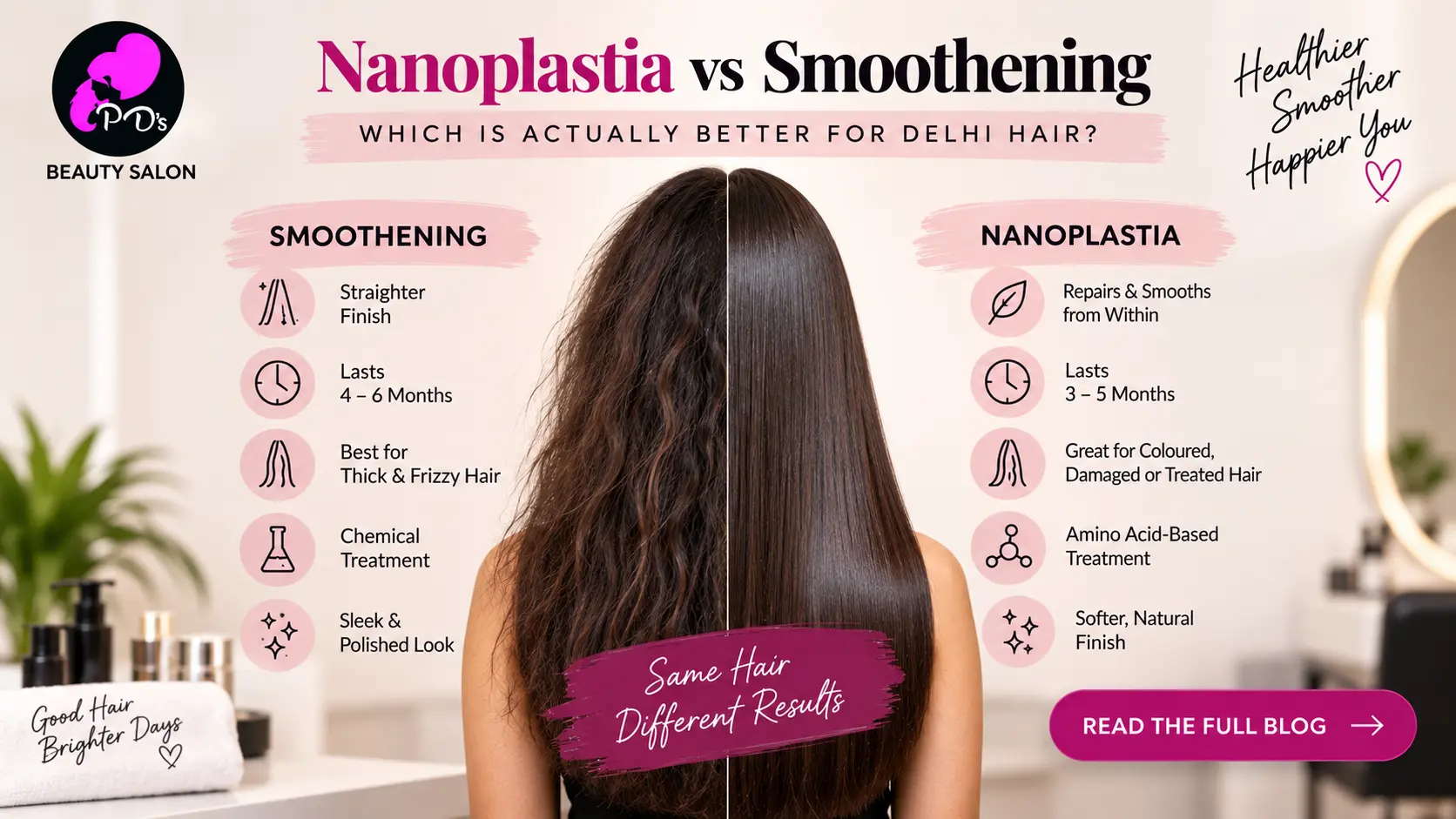
Quick Summary:
Delhi has two hair treatments that confuse people more than any other combination — nanoplastia and smoothening. They sound similar, promise similar results, and get recommended interchangeably by salons that haven’t assessed your hair properly. They’re not the same thing. This blog breaks down exactly how they differ, which one suits which hair type, and why choosing the wrong one for your hair can undo months of care in one session.
Every week at PD’s Beauty Salon, at least a few clients come in having done their research online — and still not being sure what the actual difference between nanoplastia and smoothening is. They’ve read the descriptions. They’ve watched the videos. And they’re still getting the same answer from every source: “Both are great, depends on your hair.”
That’s not wrong. But it’s not useful either.
So here is the real answer — not the version designed to sell you a treatment, but the one I give clients sitting in my chair after I’ve actually looked at their hair.
The Core Difference — In Plain Terms
Hair smoothening is a chemical treatment that breaks down your hair’s natural bonds and reforms them in a straight position using heat. It fundamentally changes the internal structure of the hair to produce that sleek, straight result. The effect is strong, the finish is polished, and the commitment is real — your hair is structurally different after the treatment, and it stays that way until it grows out or is treated again.
Nanoplastia works differently. It doesn’t break down your hair’s structure. Instead, it infuses the hair shaft with amino acids, collagen, and proteins at a molecular level — rebuilding from within rather than restructuring. The result is smoother, softer, more manageable hair that still retains natural movement. It’s not pin-straight. It’s your hair, behaving better.
This is the fundamental distinction that changes everything about which treatment you should choose.
What Hair Smoothening Actually Does
When clients say they want “smooth, straight hair,” smoothening is usually the treatment they’re picturing. Done correctly on the right hair type, it delivers exactly that — glossy, flat-ironed-looking hair that lasts for months without daily effort.
The process involves a chemical relaxant that softens and breaks the hair’s internal bonds, followed by heat application that reshapes and sets those bonds in a straight position, sealed with a neutraliser. The result is semi-permanent — lasting 4 to 6 months in Delhi’s climate — and genuinely low-maintenance in terms of daily styling.
Where smoothening works best is on thick, coarse, or naturally frizzy hair that hasn’t been heavily chemically processed. This is hair that has the structural strength to handle the process. The treatment is demanding on the hair’s internal integrity — which is why applying it to hair that’s already compromised is where things go wrong.
What Nanoplastia Actually Does
Nanoplastia is an amino acid-based treatment — the name comes from the nanotechnology that allows active ingredients to penetrate the hair shaft at a molecular level, rather than just coating the surface. The result is repair and smoothing happening simultaneously, from within.
Because it works with the hair rather than restructuring it, the finish is softer and more natural than smoothening. Clients with nanoplastia often describe their hair as feeling genuinely healthier — not just smoother. That’s because it is. The amino acids and proteins are doing real restoration work, not just surface treatment.
This is particularly significant for Delhi hair specifically. The combination of hard water mineral buildup, pollution residue, and seasonal stress — brutal summer heat followed by monsoon humidity — depletes the hair’s protein structure consistently. Nanoplastia addresses that depletion. Smoothening doesn’t.
Which Hair Type Gets Better Results From Each
Thick, coarse, very frizzy hair with no previous chemical processing
Smoothening is typically the stronger choice here. It gives a more dramatic straightening result, holds that finish longer, and is well-suited to the structural density of this hair type. If you want dead-straight, no-effort hair and your hair is genuinely thick and resilient — smoothening does what nanoplastia can’t.
Damaged, previously coloured, bleached, or highlighted hair
Nanoplastia — without hesitation. Smoothening on already-compromised hair is one of the most common causes of breakage we see walk through the door at PD’s Beauty Salon. The chemical process is intense enough that hair without adequate structural integrity can snap under it. Nanoplastia repairs while it smooths. It gives this hair type what it actually needs.
Fine or medium density hair
Nanoplastia is almost always better. Smoothening can flatten fine hair, remove its natural lift, and leave it looking limp rather than smooth. Nanoplastia keeps fine hair feeling light and natural while significantly improving its manageability.
Hair that’s been previously rebonded or relaxed
This needs a proper in-person consultation before either treatment is applied — but between the two, nanoplastia is the safer starting point because of its repairing properties. We cover the full rebonding comparison in our complete Delhi hair treatment guide.
Dry, brittle hair regardless of density
Nanoplastia. The amino acids and collagen add moisture and protein simultaneously. Smoothening on dry, brittle hair is a structural risk.
Hair that needs repair more than it needs straightening
Nanoplastia, clearly. If the goal is genuinely healthier hair rather than just a different finish, nanoplastia is the treatment designed for that outcome.
The Finish — What You Actually See and Feel
This is what most people are trying to decide between, and it’s where the treatments feel most different to the client.
Smoothening gives a polished, sleek, very straight finish. The hair looks done. If you’ve ever walked out of a salon with freshly smoothened hair and felt like you’d just walked out of a shampoo advertisement — that’s smoothening working at its best. The hair lies flat, has a glossy shine, and stays straight in almost all conditions.
Nanoplastia gives a natural, fluid finish. The hair is smoother, calmer, and more manageable — but it moves. It has a softer shine and a lived-in quality that smoothening doesn’t. Some clients prefer this. Others specifically want the polished smoothening look. Neither is better in absolute terms — they’re different aesthetics.
The question to ask yourself honestly: do you want your hair to look like it’s been professionally styled — or do you want it to look like your hair, just significantly better? The first answer points to smoothening. The second points to nanoplastia.
How Long Each Treatment Lasts in Delhi
Both treatments last 4 to 6 months in Delhi’s climate under proper aftercare. The honest caveat is that Delhi specifically shortens results compared to many other cities — hard water mineral deposits, PM2.5 pollution, and the monsoon humidity all actively work against both treatments.
The difference in longevity between the two is less about which treatment is stronger and more about aftercare discipline. A client who follows aftercare properly after nanoplastia will consistently get better results than one who cuts corners after smoothening. We cover the full aftercare picture in our how to maintain hair after smoothening blog — the core rules apply equally to nanoplastia.
Monthly hair spa sessions between treatments make a significant difference to longevity for both — particularly in Delhi’s conditions. It’s one of the most consistent patterns we see among clients whose results hold for six months versus those who fade at three.
Cost Comparison — What Actually Drives the Price
Nanoplastia typically runs slightly higher than smoothening in most professional salons. The reason is product cost — amino acid and collagen-based formulas cost more than the chemical relaxants used in smoothening. Processing time is similar for both.
What we always tell clients: the price difference between the two treatments is significantly smaller than the cost of repairing hair that’s been through the wrong treatment on the wrong hair type. Getting the assessment right upfront is the most cost-effective decision you can make.
We confirm exact pricing after assessing your hair in person. For a proper comparison of all four major hair treatments including keratin costs, see our nanoplastia vs keratin comparison and the rebonding complete guide.
What to Avoid Doing Before Either Treatment
A few things that make the treatment harder to do correctly and the results shorter-lived:
Don’t wash your hair on the day of the appointment. Natural scalp oils provide a protective layer during processing. Freshly washed hair can be more reactive.
Don’t apply oil or heavy product 48 hours before. It coats the hair shaft and prevents even product penetration.
Don’t book within four weeks of a bleach or colour appointment without getting a proper strand test first. Recently processed hair needs a specific assessment before any smoothing treatment.
Don’t skip the consultation. This is the part that tells you which treatment is actually right for your hair. Skipping it is how clients end up with the wrong treatment for their hair type — and results they’re disappointed by.
After the Treatment — The Rules That Actually Matter
The aftercare rules are nearly identical for both treatments and non-negotiable regardless of which one you choose:
· Wait 72 hours before the first wash — the bonding process is still completing.
· Switch to sulfate-free shampoo immediately and permanently until the treatment grows out.
· Wash 2 to 3 times a week maximum — daily washing shortens results significantly.
· Use a heat protectant every time before any heat styling.
· Avoid tying hair tightly for the first week.
· Skip heavy oils on the scalp for the first month — light serum on the ends is fine.
· Book a hair spa every 4 to 6 weeks to maintain the treatment’s effect.
“The number of times I’ve seen a beautiful treatment result ruined in two weeks by someone washing their hair daily with a regular shampoo — I’ve stopped counting. The treatment is half the story. What you do at home is the other half. Both treatments, done right, with proper aftercare, can last six months in Delhi. Both treatments, with poor aftercare, start breaking down in six weeks. The choice is honestly more about what happens after you leave the salon than what happens inside it.”
— Pooja Deveshwar, Founder, PD’s Beauty Salon
FAQs
What is the main difference between nanoplastia and smoothening?
Smoothening chemically restructures the hair’s internal bonds to create a straight finish. Nanoplastia infuses the hair with amino acids and proteins to repair and smooth from within without restructuring. Smoothening gives a more dramatically straight, polished result. Nanoplastia gives a softer, more natural finish while also repairing damage.
Which lasts longer — nanoplastia or smoothening?
Both typically last 4 to 6 months in Delhi’s climate with proper aftercare. Smoothening may hold its straightening effect slightly longer on very thick hair. Nanoplastia is more forgiving of minor aftercare lapses because it repairs rather than just coats.
Is nanoplastia better for damaged hair than smoothening?
Yes, significantly. Nanoplastia was designed partly for hair that needs repair alongside smoothing. Smoothening involves a chemical process that can further stress already-compromised hair. For damaged, coloured, bleached, or brittle hair — nanoplastia is the safer, more appropriate choice.
Can I get smoothening on coloured hair?
It depends on the condition of the hair and how recently it was coloured. Heavily coloured or bleached hair needs a proper strand test before smoothening. In many cases, nanoplastia is the better recommendation for coloured hair — it’s gentler and colour-safe.
Which is more expensive — nanoplastia or smoothening?
Nanoplastia typically runs slightly higher because of product cost. Both are priced based on hair length, density, and product brand. We confirm pricing after assessing your hair in person — quoting without seeing your hair isn’t something we do.
Does nanoplastia make hair completely straight?
No — and that’s by design. It significantly smooths frizz and improves manageability while retaining natural movement. If you want pin-straight hair with zero movement, smoothening or rebonding is the better fit. If you want smoother, healthier-looking hair that still moves naturally — nanoplastia delivers that.
Which is better for fine hair — nanoplastia or smoothening?
Nanoplastia. Smoothening can weigh fine hair down and flatten it. Nanoplastia keeps fine hair light, natural, and manageable without compromising its texture or volume.
How do I maintain results after either treatment?
Sulfate-free shampoo, maximum 2 to 3 washes per week, heat protectant before styling, no heavy oiling in the first month, and a professional hair spa every 4 to 6 weeks. These rules apply equally to both treatments and directly determine how long your results last.